
Therapy vs. ICF Coaching: Understanding the Difference and Choosing the Support You Need
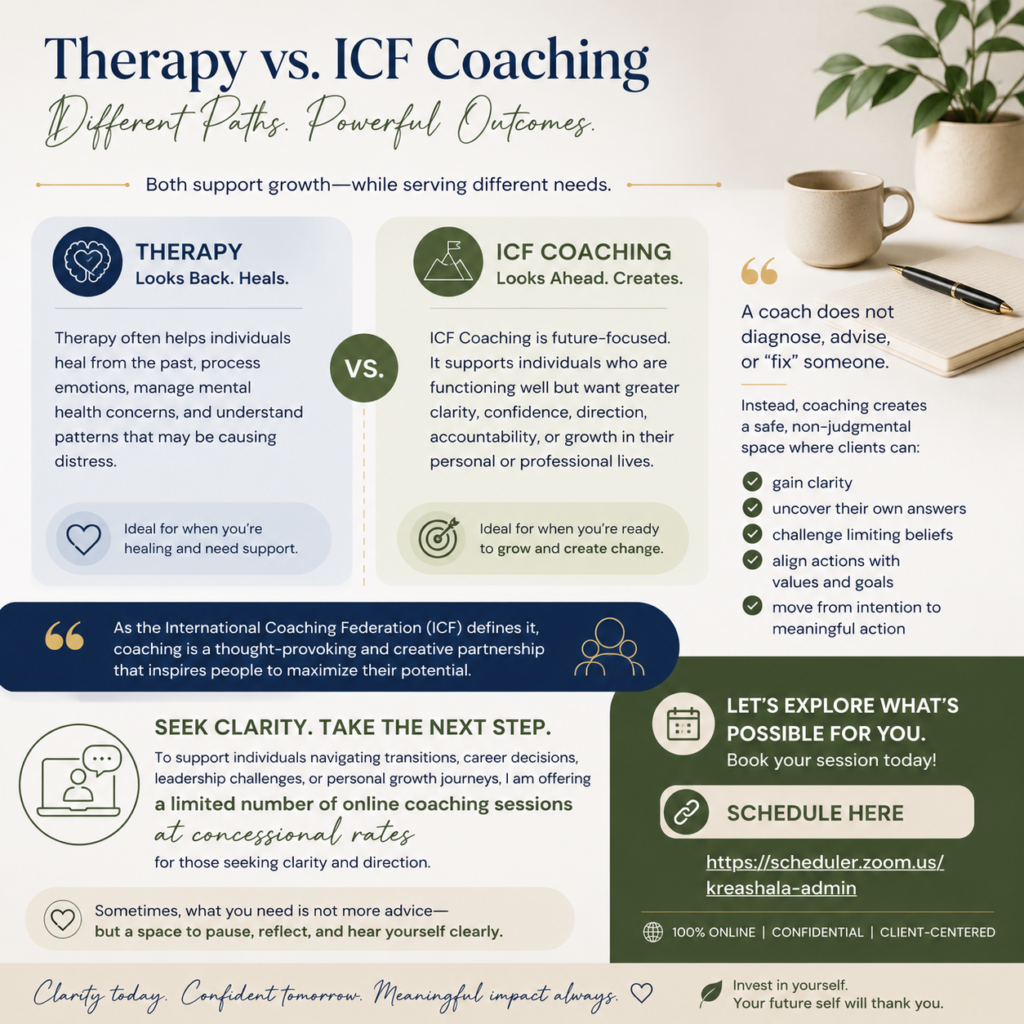
Different Paths. Powerful Outcomes.
In recent years, conversations around mental well-being, self-awareness, leadership, emotional intelligence, and personal growth have become more open and mainstream. As people increasingly seek support for navigating life transitions, stress, uncertainty, relationships, career growth, and purpose, two approaches are often discussed together — therapy and coaching. While both create supportive spaces for growth and transformation, they are not the same. Understanding the distinction between therapy and International Coaching Federation (ICF) coaching can help individuals choose the kind of support that best meets their current needs.
What is Therapy?
Therapy is a professional mental health intervention that helps individuals process emotional pain, trauma, psychological distress, behavioral patterns, anxiety, depression, grief, or unresolved experiences from the past. Licensed therapists, psychologists, psychiatrists, and counselors are trained to diagnose and treat mental health conditions. Therapy often explores:
- Emotional healing
- Trauma recovery
- Mental health challenges
- Relationship patterns
- Stress, anxiety, and depression
- Self-esteem and identity concerns
- Behavioral and emotional regulation
Therapy can be deeply restorative and is especially important when someone is struggling emotionally, psychologically, or mentally.
Therapy Often Focuses On:
✔ Understanding the past
✔ Healing emotional wounds
✔ Managing psychological distress
✔ Clinical diagnosis and treatment
✔ Coping strategies and emotional processing
What is ICF Coaching?
ICF coaching is a future-focused, collaborative partnership that supports individuals in unlocking their potential, gaining clarity, setting meaningful goals, and taking purposeful action. According to the International Coaching Federation (ICF), coaching is:
“Partnering with clients in a thought-provoking and creative process that inspires them to maximize their personal and professional potential.”
Unlike therapy, coaching does not diagnose, treat, or analyze mental health conditions. Instead, coaching assumes that the client is naturally creative, resourceful, and whole.
An ICF coach helps clients:
- Gain clarity
- Explore possibilities
- Identify limiting beliefs
- Build confidence
- Improve self-awareness
- Strengthen decision-making
- Enhance leadership capability
- Align actions with values and goals
- Create accountability and momentum
Coaching Often Focuses On:
✔ Present and future growth
✔ Goal setting and action planning
✔ Personal and professional development
✔ Self-awareness and mindset
✔ Leadership and performance
✔ Clarity, confidence, and accountability
Therapy vs. Coaching: A Simple Comparison
| Therapy | ICF Coaching |
|---|---|
| Focuses on healing and emotional recovery | Focuses on growth and future possibilities |
| May explore trauma and psychological distress | Explores goals, clarity, and potential |
| Diagnoses and treats mental health conditions | Does not diagnose or treat mental health conditions |
| Often examines the past | Primarily future-oriented |
| Led by licensed mental health professionals | Led by trained professional coaches |
| Helps individuals become emotionally stable | Helps individuals become more intentional and empowered |
Coaching is Not Advice-Giving
One of the biggest misconceptions about coaching is that a coach tells clients what to do. In reality, professional coaching is not consulting, mentoring, counseling, or advice-giving. An ICF coach does not “fix” people. Instead, coaching creates a reflective and non-judgmental space where clients can pause, think deeply, reconnect with themselves, and discover their own answers. The coach uses:
- Powerful questioning
- Active listening
- Reflection
- Accountability
- Presence and empathy
- Perspective-shifting conversations
This process often helps clients move from confusion to clarity — and from intention to meaningful action.
When Might Therapy Be Helpful?
Therapy may be the right support if someone is:
- Experiencing persistent sadness or anxiety
- Facing emotional trauma or grief
- Feeling emotionally overwhelmed
- Struggling with mental health conditions
- Experiencing burnout, panic attacks, or depression
- Needing clinical mental health support
- Looking to process unresolved emotional experiences
Seeking therapy is a sign of strength, self-awareness, and courage.
When Might Coaching Be Helpful?
Coaching may be valuable if someone is:
- Feeling stuck or uncertain
- Seeking career clarity
- Navigating a transition or life change
- Wanting greater confidence or direction
- Looking to improve leadership effectiveness
- Exploring purpose and alignment
- Wanting accountability for goals
- Trying to overcome self-doubt or limiting beliefs
- Looking for clarity in personal or professional decisions
Coaching is particularly useful for individuals who are functioning well but want to grow, evolve, and create intentional change.
The Power of Clarity
Many people today are not necessarily “broken.” They are simply overwhelmed by noise, expectations, pressure, uncertainty, or constant busyness. Sometimes, what people truly need is not more advice. They need:
- A space to pause
- Someone who listens deeply
- Questions that spark reflection
- Clarity about what matters most
- Permission to reconnect with themselves
That is where coaching can create meaningful transformation.
Coaching for Leadership, Growth, and Transitions
ICF coaching can support individuals across different stages of life and work, including:
Career and Professional Growth
- Career transitions
- Leadership development
- Workplace confidence
- Executive presence
- Decision-making
- Team and communication effectiveness
Personal Growth
- Self-awareness
- Confidence building
- Goal alignment
- Work-life integration
- Values clarification
- Personal transformation
Transition Support
- Mid-career reflection
- Role transitions
- Identity shifts
- Navigating uncertainty
- Building resilience and adaptability
My Coaching Approach
My coaching approach is rooted in empathy, reflective inquiry, active listening, and creating a safe, confidential, and non-judgmental space for exploration. I believe every individual already carries wisdom within themselves. The role of coaching is not to provide all the answers — but to help people hear their own voice more clearly. Whether you are navigating a transition, exploring career decisions, seeking greater confidence, or looking for clarity in your next steps, coaching can support you in moving forward intentionally.